
A series of short animations for the book E Majta — history turned into motion.
The films reinterpret the lives and legacies of Albanian intellectuals — Skënder Luarasi, Petro Marko, Sejfulla Malëshova, Musine Kokalari and Isuf Luzaj — through digital motion design.
Blending archival depth with a contemporary visual language, each piece is built to inform and to provoke reflection on the voices that shaped modern Albania. Not promo material: mini visual essays.
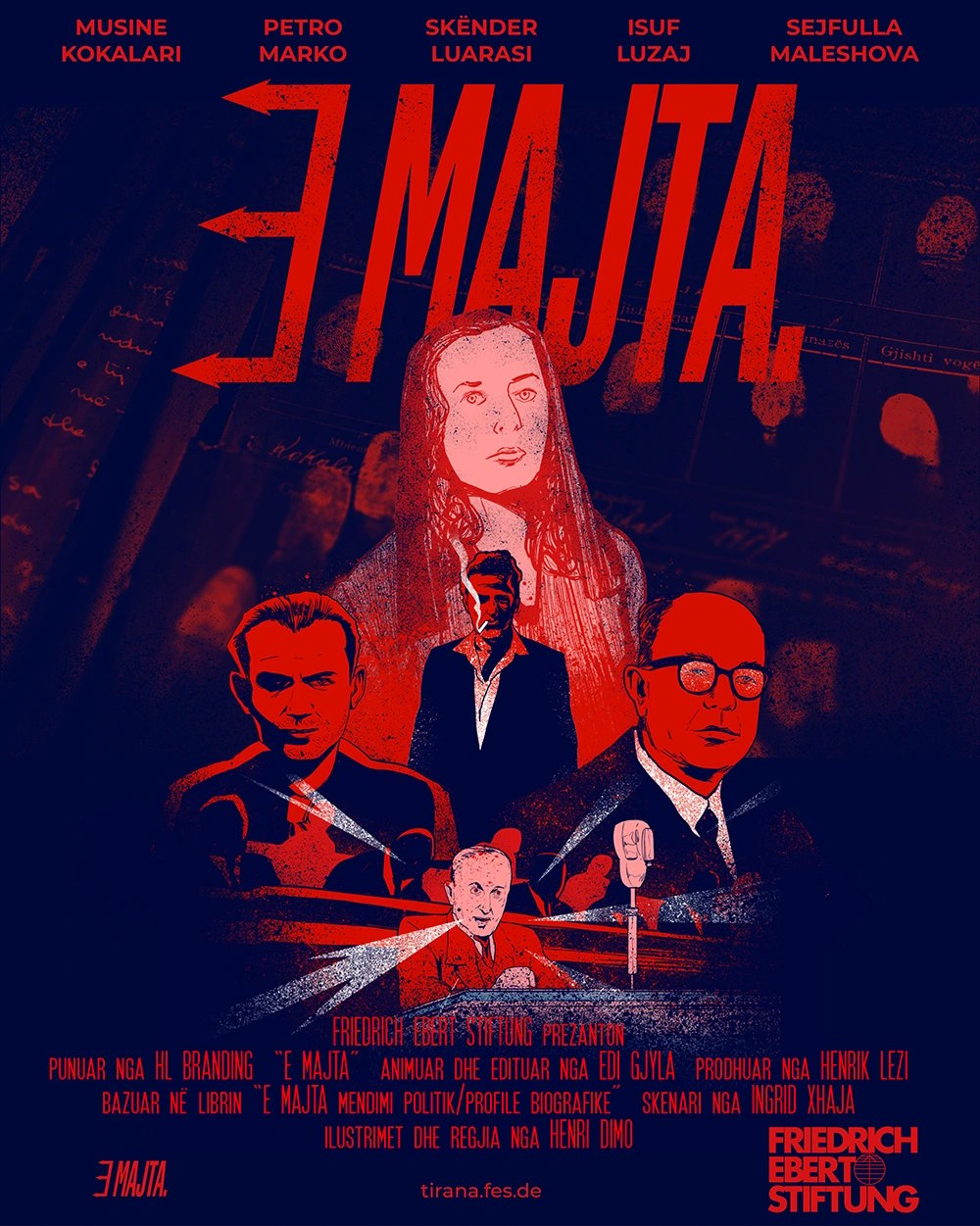
the five episodes


what was produced
Kinetic typography
Titles, dates and quotations set in motion as the narrative spine of each film — type carries the story where archival footage doesn't exist.
Archive treatment
Portraits, documents and maps recomposed in layers: halftone, grain and colour separation give a single visual register across five very different lives.
Five films, one system
Shared title cards, transitions, palette and pacing — each episode reads as its own piece and as part of the book's campaign.
Social delivery
Vertical and square cuts, episode posters and looping fragments prepared for feed and story, plus an event invitation for the book launch.
frames


frames — cont.


Musine
Kokalari

episode 01 — 1917–1983
Musine
Kokalari
Albania's pioneering woman writer,
publishing poetry and prose in the 1930s–40s
while studying literature in Rome.
She co-founded the Social Democratic Party in 1943,
opposing both the fascist occupation
and the rising communist regime.
Arrested in 1946 and condemned as an enemy of the people,
she endured prison, exile and literary silencing
until her death in 1983 — and never recanted.
Skënder
Luarasi

episode 02 — 1900–1982
Skënder
Luarasi
Writer, translator, critic and professor.
Born in Luaras to the patriot Petro Nini Luarasi,
he studied in the US and Austria
and fought with the International Brigades in Spain.
He joined the wartime resistance,
then taught Western literature in Tirana
and wrote biographies of Migjeni, Ismail Qemali and Isa Boletini.
A lifelong leftist with humanist principles,
he grew critical of the Hoxha regime and faced censorship
and marginalisation without compromising.
Sejfulla
Malëshova

episode 03 — 1900–1971
Sejfulla
Malëshova
Poet and ideologue writing as Lame Kodra,
and one of the early high-ranking figures of Albanian communism.
He rose fast during and after the war — Central Committee member,
Minister of Culture 1944–46, chief advocate of socialist realism in literature.
In 1946 he was accused of deviationism, expelled from the party
and stripped of power. He spent his last years in isolation
and poverty in Fier, dying alone in 1971.
Isuf
Luzaj

episode 04 — 1913–2000
Isuf
Luzaj
Philosopher, writer, social democrat and anti-fascist.
Born in Kanina near Vlorë, he studied in Shkodër
and became active in leftist circles.
During the war he opposed both the occupation
and the hardline communist movement, warning in a 1944
memorandum that communism would take the south by force and terror.
After 1944 he fled to Italy, living in exile as a labourer and writer.
He never returned permanently, and died in 2000.
Petro
Marko

episode 05 — 1913–1991
Petro
Marko
Writer, journalist and communist who fought in the Spanish Civil War.
Born in Dhërmi, he volunteered for the International Brigades —
the material of his novel Hasta la Vista.
He joined the anti-fascist resistance and at first supported the new regime.
His independence brought imprisonment, exile and censorship —
largely over his criticism of Albanian-Yugoslav ties and his distance
from socialist realism. He stayed prolific, and kept his ideals, until his death in 1991.

Let's make the next one.
design with guts — art with soul